STILL LIFE DRAWING – A FOUNDATION FOR LEARNING ART
Contents
What Is Still Life Art?
According to Wikipedia:
“A still life (plural: still lifes) is a work of art depicting mostly inanimate subject matter, typically commonplace objects which are either natural (food, flowers, dead animals, plants, rocks, shells, etc.) or man-made (drinking glasses, books, vases, jewelry, coins, pipes, etc.).”
Source: Wikipedia – Still Life.
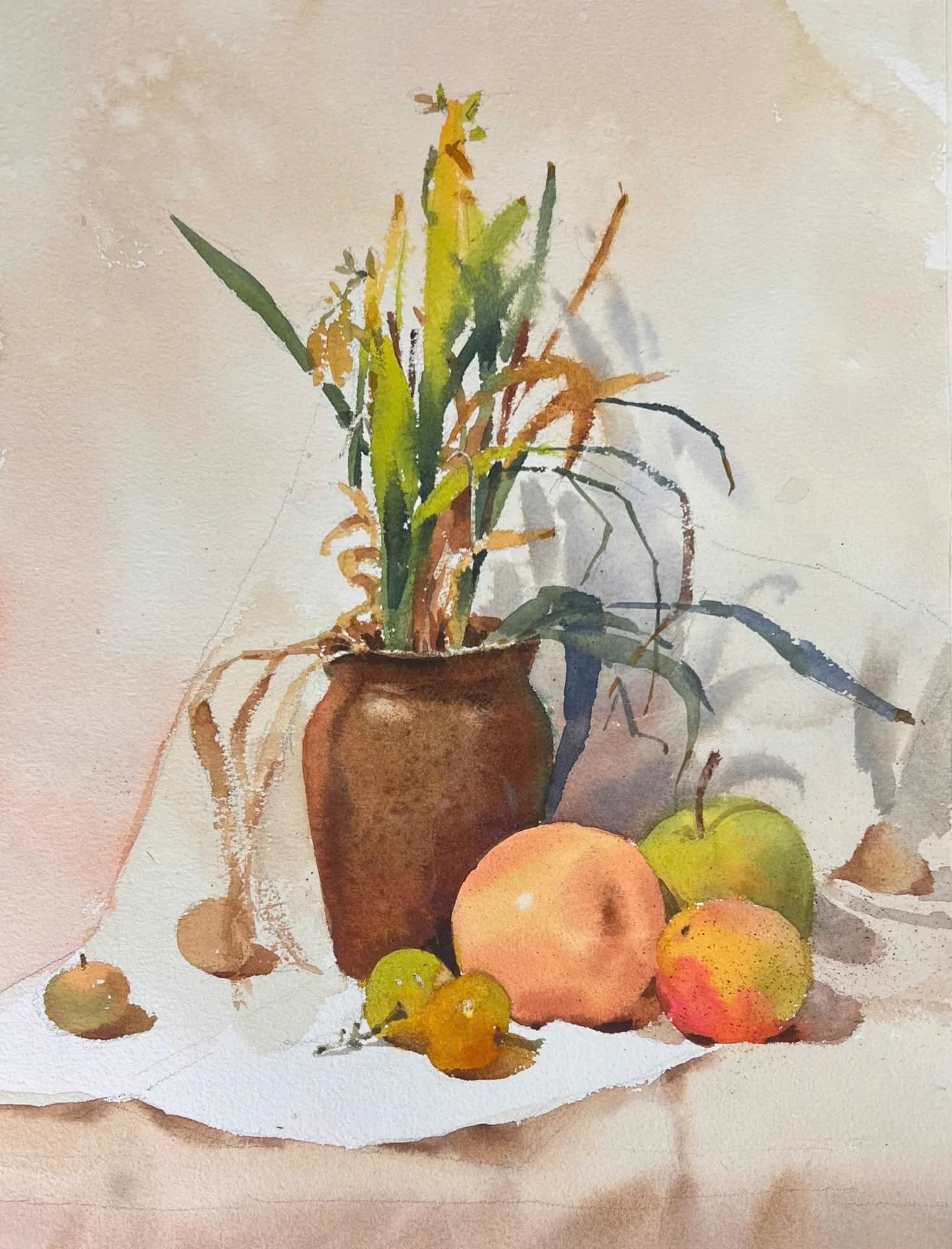
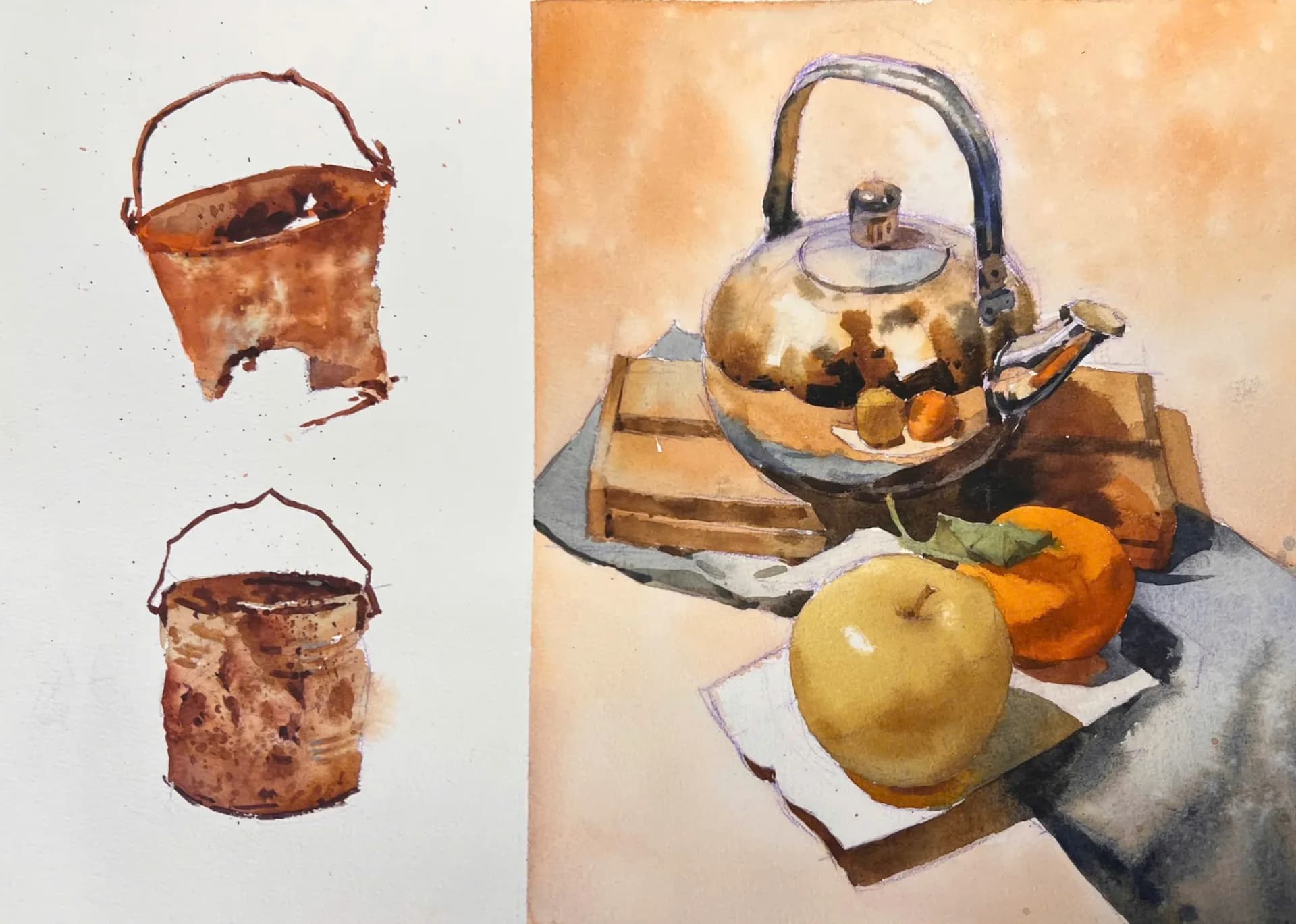
In painting, these objects are often deliberately arranged with attention to composition, lighting, and color, creating a scene for the artist to observe and depict.
Beyond being an independent genre of art, still life drawing is also widely used in art education. By studying familiar objects, beginners can develop their observation skills and gradually understand fundamental principles such as form, proportion, light, and composition.
Why Start Learning to Draw with Still Life?
1. Developing Observation Skills
Observation is one of the most important skills in learning to draw.
When drawing still life, students learn to carefully examine the shapes, sizes, proportions, and relationships between objects rather than relying on how they remember those objects.
For example, when observing a vase, an artist needs to consider its height relative to its width, the curvature of its body, the shape of its opening, and its position in space.
Through regular practice, students gradually develop the ability to observe, analyze, and translate what they see into lines and forms on paper.
2. Understanding Form and Proportion
Most complex objects can be simplified into basic geometric forms such as spheres, cubes, cylinders, and cones.
For example, an orange resembles a sphere, a drinking glass can be simplified into a cylinder, and a book can be understood as a rectangular prism.
When beginning a drawing, students first identify the overall structure and compare the proportions of different parts before focusing on smaller details.
Practicing with basic geometric forms helps students understand how to represent three-dimensional objects on a two-dimensional surface while reducing common mistakes in proportion and structure.
3. Understanding Light and Tonal Values
The distribution of light and shadow helps artists convey the volume and structure of an object.
When light falls on an object, its surface reveals areas of highlight, midtone, and shadow with varying tonal values. The object also casts a shadow onto the surrounding surface.
Through still life exercises, students learn to observe the direction of light, identify light and dark areas, and create smooth transitions between tonal values.
For example, when drawing an apple in graphite, carefully controlling the range and transitions of tonal values helps create the illusion of three-dimensional form on a flat sheet of paper.
Through this process, students gradually understand the relationship between light, tonal value, and form, learning how to use tonal variation to convey the volume of an object.
4. Developing Composition and Spatial Awareness
A still life drawing is more than a collection of individually rendered objects.
The placement, size, and spacing of objects, the negative space around them, and the distribution of light and dark areas all contribute to the overall composition.
During practice, students learn to observe the relationships between objects, determine their placement on the paper, and organize the composition to achieve balance and a clear focal point.
Overlapping forms, relative sizes, and the positioning of objects also help students understand how to create a sense of depth and space.
Through exercises that gradually increase in complexity, students develop a stronger understanding of composition and spatial relationships in drawing.
From Still Life to Other Forms of Art
The knowledge and skills developed through still life drawing can be applied across a wide range of artistic genres and practices.
In portrait drawing, understanding form, structure, proportion, and light helps artists analyze facial features and convey the volume and distinctive characteristics of the subject.
In landscape painting, knowledge of composition, tonal values, and space helps artists organize foreground, middle ground, and background, create depth, and depict changes in natural light.
In sketching, observation skills, the ability to simplify forms, and an understanding of proportion help artists capture the essential characteristics of subjects and scenes within a limited amount of time.
When working with painting media such as watercolor, acrylic, or oil, an understanding of light, tonal values, and form helps artists use color to convey volume, texture, and the distinctive qualities of different subjects.
Whether choosing portrait drawing, landscape painting, or sketching, students can apply the fundamental principles of form, proportion, composition, and light developed through still life practice.
Starting with still life is a valuable choice for anyone who wants to build a strong foundation in art before exploring a wider range of subjects, techniques, and artistic expressions.
A little art insight from Lam Art Studio.